

TECHNOLOGY IN DEFENSE OF HUMAN LIFE AND UNDERSTANDING
Protect lives.
Make understanding possible.
Prevent exploitation.
Our work confronts those who profit from violence, ignorance, and division. We build open-source tools that help people recognize danger, understand what is happening, and act for themselves.
Discover our productsPROJECT REVIVE SOLUTIONS OPEN SOURCE. FULLY CAPABLE. BUILT TO STAY YOURS.
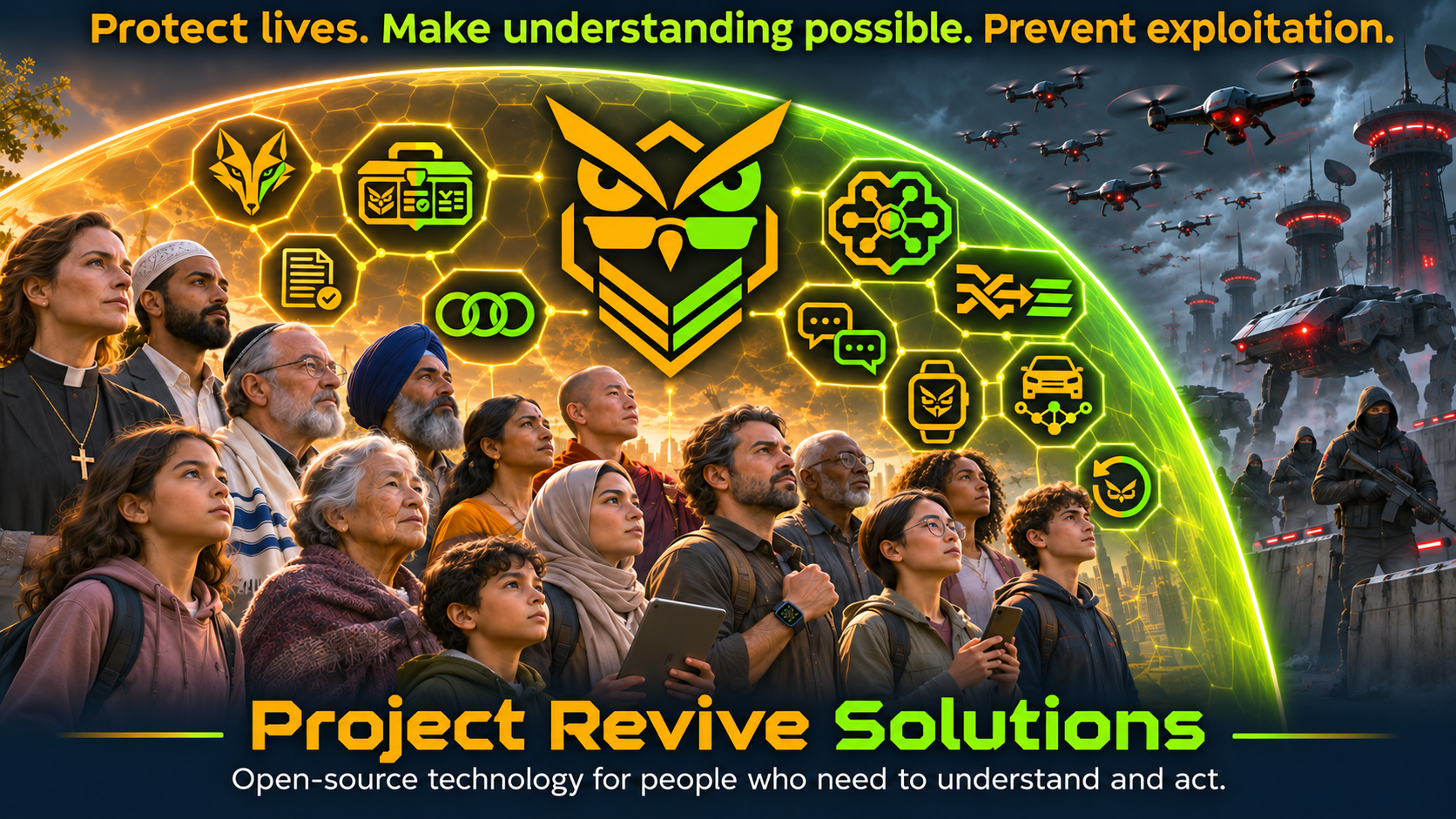
Human life and understanding are worth defending. That is why this company exists.
THE COMMON THREAD
We teach open-source AI
what the data means.
Vixen delivers threat warnings on a cellphone, even without internet access. Vehicle-SLM learns the language of vehicle systems. Intellectus connects programming languages through shared meaning so developers can focus on business goals.
The common thread is ontology-based training of existing open-source AI models. We teach the relationships behind the data: which events form an attack pattern, how vehicle messages express intent, and how different programming languages express the same business logic.
 Vixen
Use ontology-based Low-Rank Adaptation (LoRA) training to connect wireless events to attack patterns and timelines. Turn complex evidence into an understandable warning.
 Vehicle-SLM
Connect an intended action to a vehicle’s signaling language. Ontology-based training teaches an existing open-source AI model the relationships behind the messages.
 Intellectus
Focus on the business goal. An ontology-trained open-source AI model connects Python and TypeScript through shared semantic meaning.
Useful answers across different domains, built by teaching existing open-source AI models what the data means.
01 / THE PORTFOLIO
Complexity underneath.
Clarity in your hands.
From our first breakthrough, Insight, to today’s products, we turn complex systems into capabilities people can use.
OPEN-SOURCE PROTECTIVE INTELLIGENCE
Vixen
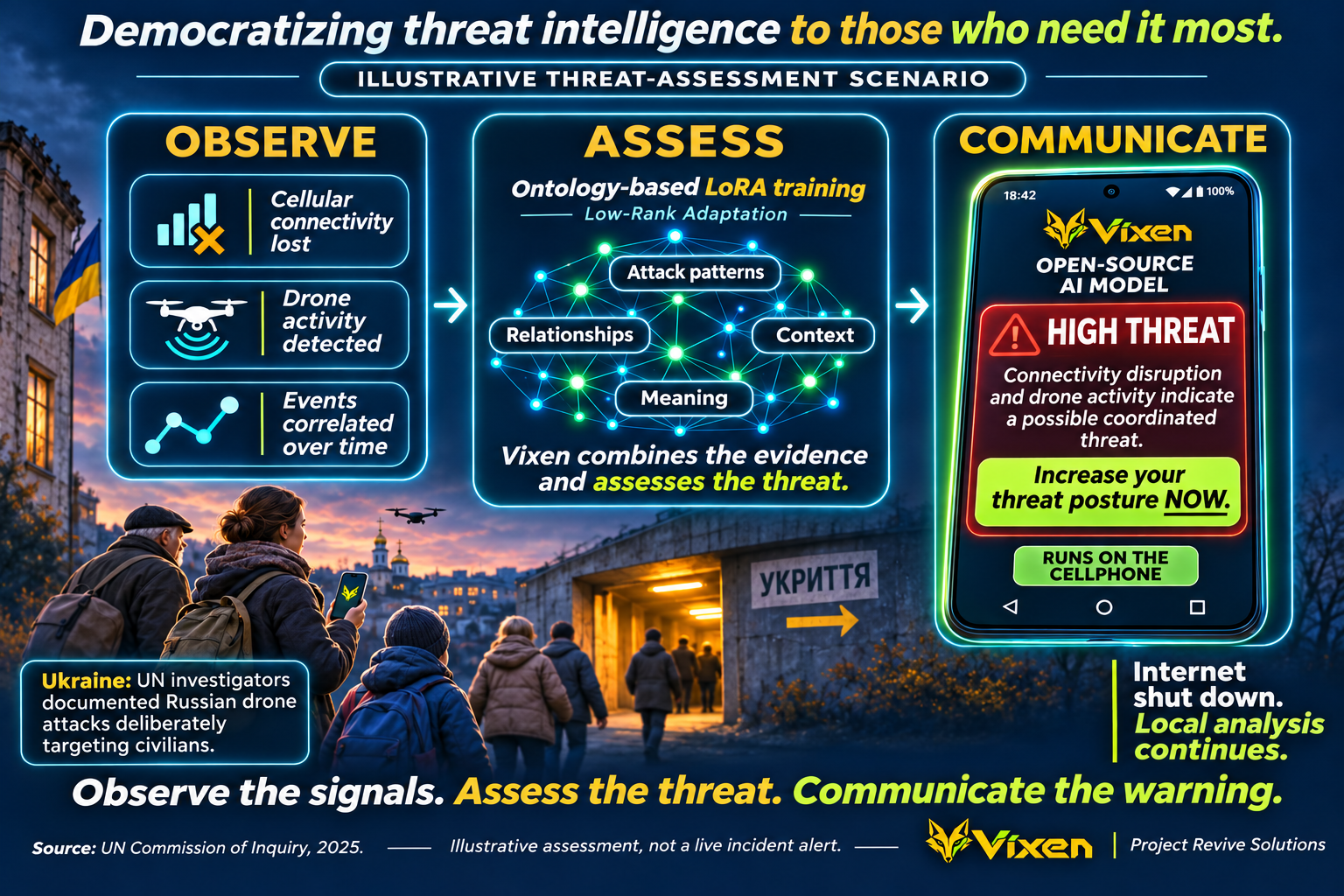
Democratizing threat intelligence to those who need it most.
A refugee should not need a security operations center or a fortune to understand the danger around them. Vixen puts a radical idea on Android: turn the invisible language of wireless attacks into a warning anyone can understand.
Get early warning of targeting in plain language, with technical evidence for post-incident review. Vixen’s open-source small language model (SLM) runs directly on the cellphone, so local analysis continues when a regime shuts down internet access in a targeted area.
Ontology-based Low-Rank Adaptation (LoRA) training connects Wi-Fi and Bluetooth packets to known attack vectors and events across timelines.
“Your network is under attack, increase your threat posture NOW.”
Use AI to protect civilians from AI-enabled terror. Russian forces have deliberately targeted civilians with drones in Ukraine, according to UN investigators. Separate reporting describes an AI-guided Russian drone that killed three civilians in Zaporizhzhia. These attacks make the civilian stakes of weaponized AI concrete.
Vixen applies an open-source AI model to the defensive problem: combine connectivity disruption, supported drone-sensor reports, and events across time; assess the threat; and communicate that assessment in plain language. The open-source AI model runs on the cellphone, so losing internet access does not stop local analysis.
Open source. Inspectable code. Protection without a wealth requirement.
Visit the Vixen product pageExplore Vixen
Democratizing threat intelligence to those who need it most.
A refugee should not need a security operations center or a fortune to understand the danger around them. Vixen brings sophisticated wireless analysis to Android, translating complex evidence into language people can act on.
Local threat analysis continues when internet access is shut down because Vixen’s open-source small language model (SLM) runs directly on the cellphone.
Vixen uses ontology-based Low-Rank Adaptation (LoRA) training of an existing open-source small language model (SLM) to relate Wi-Fi and Bluetooth evidence to known attack vectors. It deconstructs deauthentication events and correlates activity across timelines. The open-source AI model is deployed directly on the cellphone. Its analysis runs locally without an internet connection, keeping threat intelligence available when a regime cuts internet access to a targeted area.
Vixen recognizes patterns of disruption and possible targeting, provides early warning in plain language, and preserves the technical evidence for post-incident analysis.
Your network is under attack, increase your threat posture NOW.
Open source. Inspectable code. A warning should not be a luxury.
PROPRIETARY SEMANTIC TRAINING
Notella
Notella is the proprietary PRS training tool for teaching a language model to interpret the temporal morphology of a semantic model represented by the Vixen ontology. It applies ontology-guided semantic Low-Rank Adaptation (LoRA) to connect domain meaning, evidence provenance, and temporal evolution within the training curriculum.
The ontology encodes the semantic model through entities, attributes, and typed relationships. Training scenarios express successive states of that model, including changes in observed attributes, the emergence of relationships, and the reinforcement or withdrawal of evidential support. The training objective is semantic interpretation of those transitions: how an evolving configuration changes the assessment of an incident and the protective response it warrants.
In the refugee camp scenario, concurrent Wi-Fi and Bluetooth Low Energy (BLE) flooding establishes communications disruption within a shared operational context. Multiple drone signatures then emerge and increase in signal strength across successive observations. The morphology of the combined evidence indicates an escalating attack threat and produces an evacuation warning.
Vixen remains the flagship application that communicates the threat assessment. Notella supplies the specialized training methodology and curriculum tooling for this approach to temporal semantic interpretation. Model training is centralized; the target small language model performs local inference on the user's phone.
Notella repository and documentation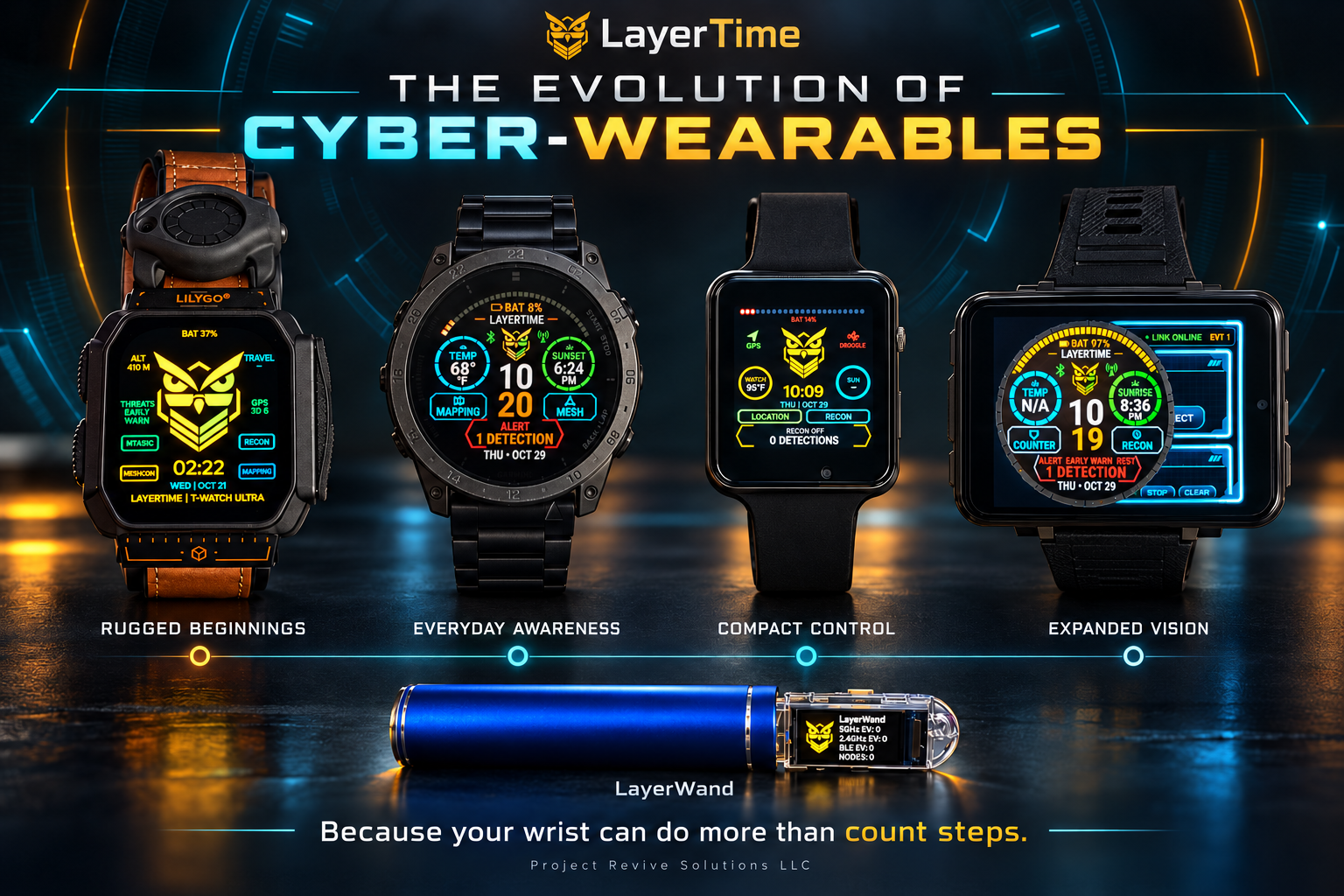
FIELD TECHNOLOGY
 LayerTime
Because your wrist can do more than count steps.
Born from a real question: how would you know if someone were using wireless technology to watch your room, and how would you reach anyone if normal communications failed?
LayerTime brings passive wireless awareness, GPS positioning, and off-grid mesh communications to the LILYGO T-Watch Ultra. The wider ecosystem connects wearable interfaces with external radio sensors.
- Passive Wi-Fi and Bluetooth signature detection
- Position and grid references without a cloud connection
- Choose MeshCore or Meshtastic communications
Explore LayerTime
Know more about the wireless world around you. LayerTime combines passive Wi-Fi and Bluetooth signature detection, GPS positioning, and off-grid mesh communications on the LILYGO T-Watch Ultra.
Recognize signals associated with trackers, surveillance equipment, and network disruption. Record encounters, get a grid reference, and choose MeshCore or Meshtastic for communication beyond cellular coverage.
The wider ecosystem brings wearable interfaces and external radio sensors together. Choose the hardware that fits the way you operate.
 REGALIA / A CARES EDITION
NONPROFIT OPERATIONS / VERSION 1.0 RELEASED
 CARES
Your volunteers came to serve.
Let them get back to it.
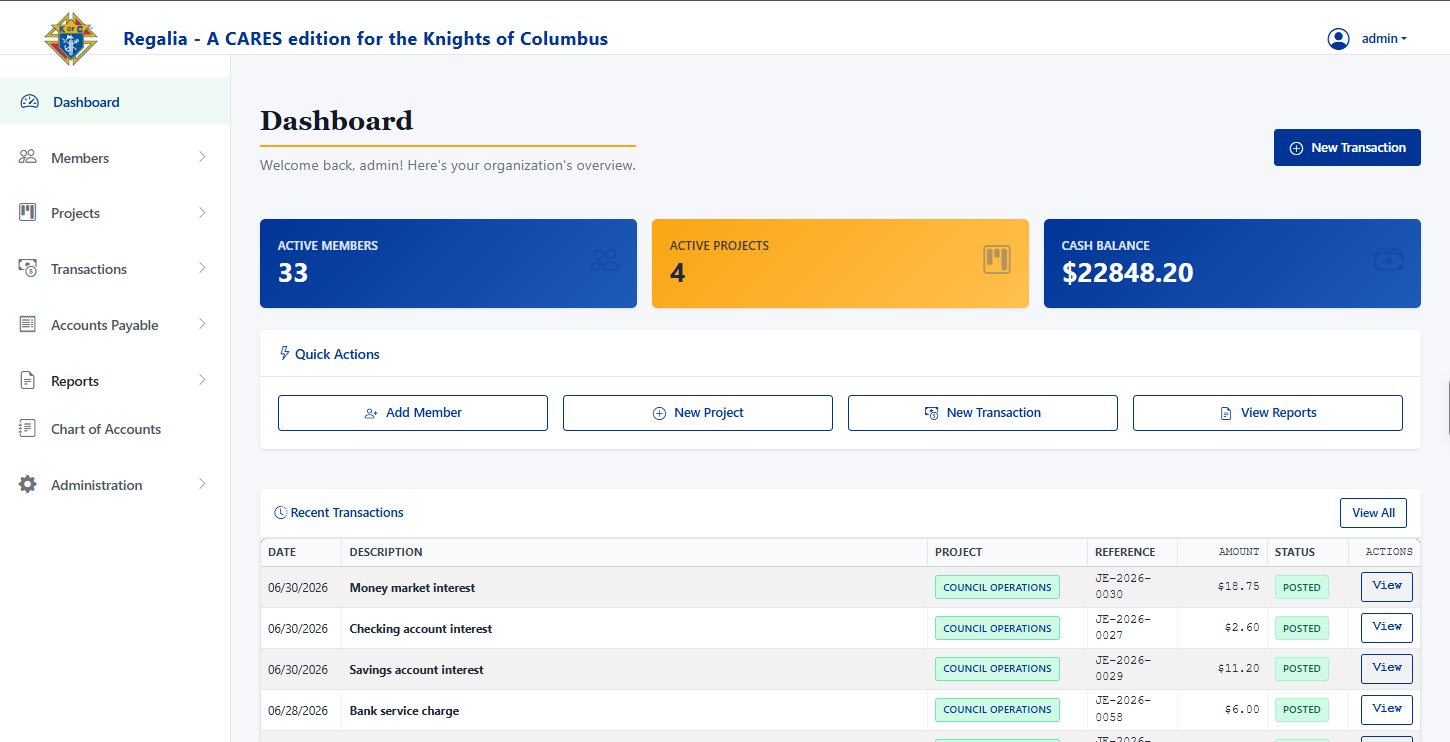
Running a community organization should not require becoming an accountant. CARES brings membership, projects, volunteer assignments, accounting, and reporting into a connected operating record.
Volunteers record familiar activities such as dues, donations, and expenses. The accounting engine creates the journal entries underneath. Accountants retain a full debit-and-credit interface for the work that needs it.
- Simple entry for volunteers and full journal entry for accountants
- Project budgets, member records, and financial statements together
- REGALIA applies the same core to Knights of Columbus councils
Built as a way to give back to the Knights of Columbus. Released as open-source software so the contribution can go further.
Explore CARES
Community Accounting & Resource Engagement System. CARES 1.0 is released. It exists to put professional financial tools within reach of volunteer-led organizations.
A volunteer records a donation, dues payment, or expense in simple mode. CARES creates the journal entry. An accountant can work directly with debits, credits, and multi-line entries. Both use the same organizational record.
Membership import and export, project budgets, volunteer assignments, a configurable chart of accounts, role-based access, audit history, and financial statements connect the people doing the work to the numbers behind it.
REGALIA is the Knights of Columbus edition. It applies council terminology and workflows to the shared CARES core. The project began as the founder’s way of thanking an organization whose members had helped him as a child.

Keep-Safe
Your project’s CTRL-Z.

DeepTest
Find the capabilities your AI quietly removed.

UntangleIt
Turn sprawling code into pieces you can understand.
FREE, OPEN-SOURCE VS CODE EXTENSIONS
 MikeVan’s AI Development Toolkit - Polyglot
Built because AI screwed up his code.
Our founder created the toolkit to keep AI from screwing up his code. When it did, he wrote a tool to fix it. Then came the thought: “I’m sure I’m not the only one having these issues.”
So he released the tools as free, open-source VS Code extensions.
- Keep-Safe is your project’s CTRL-Z. Checkpoint before the prompt. Restore when the AI goes sideways.
- DeepTest exposes missing capabilities. Check whether your AI quietly removed whole branches of functionality.
- UntangleIt makes sprawling code manageable. Break that 100,000-line main.py into smaller, cohesive pieces that are easier to understand and work with.
Polyglot brings the toolkit across languages, with Python, TypeScript, and JavaScript support and adapters for React, Vue, Svelte, and Angular.
Explore the toolkit
Built because AI screwed up his code.
Our founder created the toolkit to keep AI from screwing up his code. When it did, he wrote a tool to fix it. Then he thought, “I’m sure I’m not the only one having these issues,” and released the tools as free, open-source VS Code extensions.
Keep-Safe
Your project’s CTRL-Z. Create a checkpoint before the prompt and restore the project when the AI goes sideways.
DeepTest
Find the capabilities your AI quietly removed. Run your tests, expose untested code, and examine what changed before accepting the result.
UntangleIt
Make sprawling code understandable. Take that 100,000-line main.py and break it into smaller, cohesive pieces that are easier to understand and work with. Measure the pieces and run the tests again.
Polyglot extends the toolkit across development languages and frameworks. The tools give you evidence and a way back. You make the decisions.
SEMANTIC MODELLING / TOOLKIT 2.0
MikeVan's AI Development Toolkit 2.0 - Intellectus
What if we could teach AI
what our code actually means?
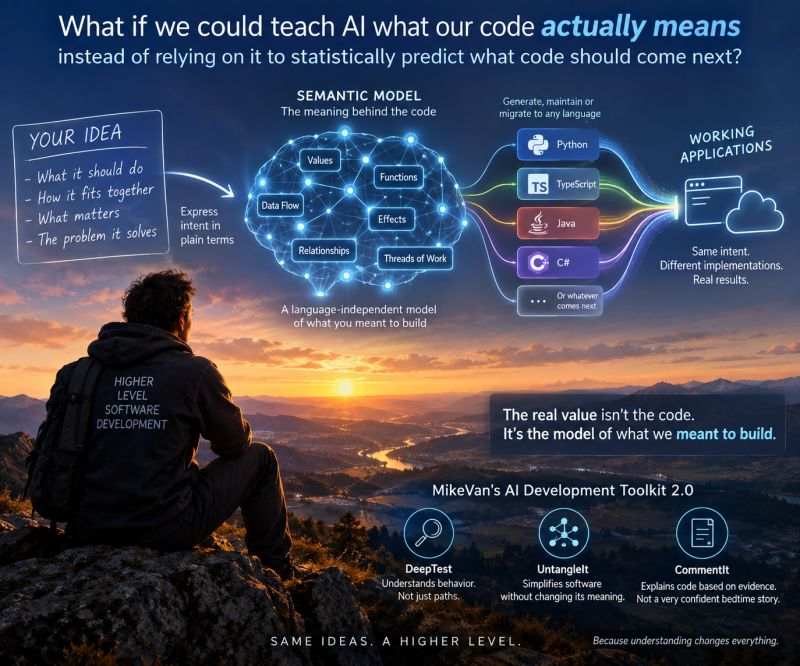
Intellectus is MikeVan’s AI Development Toolkit 2.0. It puts a language-independent semantic model at the center of development: what the software should do, how its parts fit together, and the problem it solves.
The model captures values, functions, data flow, effects, relationships, and threads of work. Ontology-based training of existing open-source AI models connects code to that meaning, giving development a foundation beyond predicting what code comes next.
The real value is the model of what we meant to build. Generation, maintenance, and migration serve that intent, with the programming language as an implementation detail.
Working with Python and TypeScript today. Broader language generation and migration are part of the 2.0 development direction.
Visit the Intellectus product pageExplore Intellectus
What if we could teach AI what our code actually means?
Intellectus is MikeVan’s AI Development Toolkit 2.0. Its focus is semantic modelling: a language-independent representation of what the software should do, how its parts relate, what matters, and the problem it solves.
The semantic model captures values, functions, data flow, effects, relationships, and threads of work. Ontology-based training of existing open-source AI models connects implementation to those meanings.
That model becomes the foundation for generating, maintaining, and migrating software while preserving intent. The programming language becomes an implementation detail.
The 2.0 direction brings DeepTest’s understanding of behavior, UntangleIt’s preservation of meaning during simplification, and CommentIt’s evidence-based explanation together around the semantic model.
Working with Python and TypeScript today. Additional languages and the broader generation and migration workflow are in development.
The real value is not the code. It is the model of what we meant to build.
VEHICLE-SLM
Teach the model what the signals mean.
ONTOLOGY-BASED AI / LINGUISTIC CAN
Vehicle-SLM
Understand the vehicle
through the language it speaks.
Connect what you want a vehicle to do with the messages its systems understand. Vehicle-SLM uses an open-source small language model (SLM) to generate candidate CAN frames from vehicle context, observed traffic, and operator intent.
The same action can have different encodings across manufacturers. An ontology connects the shared meaning to vehicle families, signal grammar, and operating context. Related vehicles share dialects; OBD-II supplies a Rosetta Stone between standardized meanings and proprietary messages.
The training pipeline turns existing DBC definitions into structured examples that connect vehicle context and intent to CAN frames. An existing small language model learns these relationships through fine-tuning.
The research corpus spans 86 parsed DBC files across 14 manufacturer families, producing 3,408 structured training pairs. The approach puts a model of meaning at the center of vehicle intelligence.
Explore Vehicle-SLM
Understand the vehicle through the language it speaks.
Vehicle-SLM’s open-source small language model (SLM) generates candidate CAN frames from operator intent, vehicle metadata, and observed traffic. It connects what you want to express to the vehicle’s signaling language.
An ontology organizes the relationships among a requested action, the physical quantities behind it, vehicle families, encoding conventions, and operating context.
A brake command has a shared meaning even when manufacturers express it through different message identifiers, bit positions, scales, and byte order. Related vehicles share encoding conventions like dialects within a language family. Individual signals combine like meaningful components of a word, and operating context determines how a message is interpreted.
OBD-II serves as a Rosetta Stone. Standardized diagnostic values provide a known meaning that can be correlated with proprietary traffic, connecting the familiar and unfamiliar forms.
The corpus analysis covers 86 parsed DBC files across 14 manufacturer families and generates 3,408 structured training pairs. The pipeline connects vehicle metadata, ambient traffic, and operator intent to candidate CAN frames, then fine-tunes an existing open-source small language model (SLM) on those relationships.
The architecture applies language learning to vehicle communications. Evaluation holds out manufacturer families and checks exact frame bytes to examine whether the model learns encoding relationships beyond memorized examples.
ONE APPLICATION
20 target languages. No template rewrites.
LANGUAGE ACCESS / DELOS FOR FLASK
 Delos
Remove language as a barrier to understanding.
Read an application in a language you understand, without searching for a translation button. Delos automatically adapts its pages to your browser’s language preference.
Our founder saw incorrect interpretations become sources of conflict while working as a professional translator with German, Arabic, and English in the early 1990s. Delos exists to remove language as a barrier to understanding.
Understanding should not depend on which language someone speaks. Delos brings that purpose into software: the application adapts to the reader, helping meaning reach people across language boundaries.
- 20 target languages, including Arabic, Hindi, Spanish, and Swahili
- Local inference through Ollama or a compatible cloud endpoint
- Content-aware caching avoids repeating inference for unchanged pages
- A Project Gutenberg reader demonstrates the integration
Add automatic translation to a Flask application without rewriting its templates. Bring the application to the reader in a language they understand.
Explore Delos
The purpose of Delos is to remove language as a barrier to understanding.
Read the application in a language you understand. Delos translates pages automatically to match your browser’s language preference, without a translation button or a template rewrite.
In the early 1990s, our founder worked as a professional translator with German, Arabic, and English. He saw incorrect interpretations become sources of conflict. Delos grows from that experience: people need access to the meaning behind the words.
Delos adapts applications to the reader, so people can access their content in a language they understand.
The Flask implementation adapts rendered pages to a reader’s browser language without rewriting templates. It includes 20 configured target languages, local or hosted inference, and content-aware caching. A Project Gutenberg reader provides a reference implementation.
INSIGHT / LATE 1990s
The first breakthrough.
More than a quarter of a century ago, our founder built his first truly innovative product: Insight, an online commerce platform for Realtor associations.
Insight combined credit-card authorization while customers waited, PGP-based transaction encryption, and direct integration with an existing proprietary database. It connected the storefront to the systems associations already used to run their businesses.
It attracted attention within the Realtor technology community and established an ambition that still drives the work: build capabilities that change what people expect from technology.
EARLY COMMERCE / THE MEAL-PLANNING KIOSK
Dinner inspiration.
A complete shopping trip.
In a separate project more than thirty years ago, our founder developed a kiosk that displayed photographs of prepared food. Shoppers chose a main, two sides, a dessert, and the number of people coming to dinner.
The software calculated ingredient quantities from the recipes, generated a shopping list in store order, and provided a coupon to purchase everything. The market opportunity closed before launch; the thinking behind it remained.
WHY THE COMPANY EXISTS
Open source. Fully capable.
Built to stay yours.
Project Revive Solutions exists to protect open-source intellectual property and keep these products available to the people who use and build them.
These are complete tools, not stripped-down editions designed to push you toward a paid product. We release the source so you can inspect, use, modify, and contribute under each project’s open-source license.
The company’s purpose is to defend that work against patent abuse, infringement, and attempts to turn shared innovation into proprietary control. All the AI models we use are open source.
The company exists to defend the work and its independence. The products exist to serve you.
03 / OUR STANDARD
Make the impossible
undeniable.
Question the ceiling.
Insight began with an opportunity to bring association business online. Every project starts by questioning what technology should make possible.
Engineer the leap.
Carry ambitious thinking through to tangible products and capabilities people can experience.
Let the work prove it.
Build capabilities people can experience. Make the code available for inspection. Give people the evidence to judge the work for themselves.
PROJECT REVIVE SOLUTIONS
Find the capability
you need.
Explore the products, examine the code, and see what the technology makes possible.
Explore the portfolio